Article: The Making of The Illustrated Oracle
The Making of The Illustrated Oracle
Most oracle decks are printed and boxed by a machine, and that is the beginning and end of the story. The Illustrated Oracle was built the other way round. Before it was a 77-card deck people could hold and shuffle, it was a question I kept returning to on the jewellery bench: what would an alternative to tarot look like if it were made the way I make a ring — by hand, in small runs, with materials chosen rather than defaulted to?
That question is the whole subject of this post: the illustrations, the gilt-edged card stock, the soft-touch A5 guidebook, and — for the Bespoke edition — a hand-finished gold vermeil buckle set with a gemstone, made with the same tools and techniques I use on every engagement ring and pendant that leaves this studio.
Seventy-seven cards, illustrated rather than templated
Every one of the 77 cards in The Illustrated Oracle was illustrated individually, not assembled from a stock symbol set. Cards like Disclosure, Gravitas and Celestial each carry their own artwork and their own short, specific meaning in the guidebook — written to be read in a minute, not studied for an hour, which is the main reason people tell us they reach for an oracle deck over a traditional tarot deck when they're new to reading cards.

The deck fanned and revealed — each of the 77 cards illustrated on its own, none repeated or templated.

The Celestial card — a gold and gemstone sunburst, the one illustration in the deck that could only belong to a jewellery house.
The card edges are finished in a thick linen laminate rather than a thin gloss coat. It's a small, almost invisible decision on a spec sheet, but it's the difference between a deck that feels disposable after a few readings and one that shuffles cleanly for years — the same logic I apply to choosing a hard-wearing setting over a delicate one for a ring that's worn every day.
The guidebook: one card, one page, every time
Each card has its own double-page spread in the A5 soft-touch guidebook, with room to read both the card's meaning and the thought it's meant to prompt — not a one-line keyword squeezed under a thumbnail. It's written in plain language on purpose: an oracle deck should be an easier starting point than tarot, not a second deck of jargon to learn.

The companion guidebook — one double-page spread per card, soft-touch A5.
"Others ask you to make room in your mind for a different view of the world — for truths you hadn't considered yet." — from the Disclosure spread

The Disclosure spread, up close — one of 77 individually illustrated cards.

Reading a draw straight from the deck — no app or extra reference needed.
Three editions, one deck
The deck itself never changes between editions — what changes is how it's presented, in the same way a ring design can move from a simple band to a fully bespoke setting without changing the stone at its centre.
- Entry — the 77-card deck with the digital guidebook. The most direct way to start reading.
- Signature — the deck with the printed A5 soft-touch guidebook, for readers who want the physical book in hand.
- Bespoke — deck, guidebook and a hand-stitched leather case closed with a gold vermeil, gemstone-set buckle.

The Bespoke edition: case, guidebook and deck, laid out together.
The case, and the buckle that links it to the jewellery bench
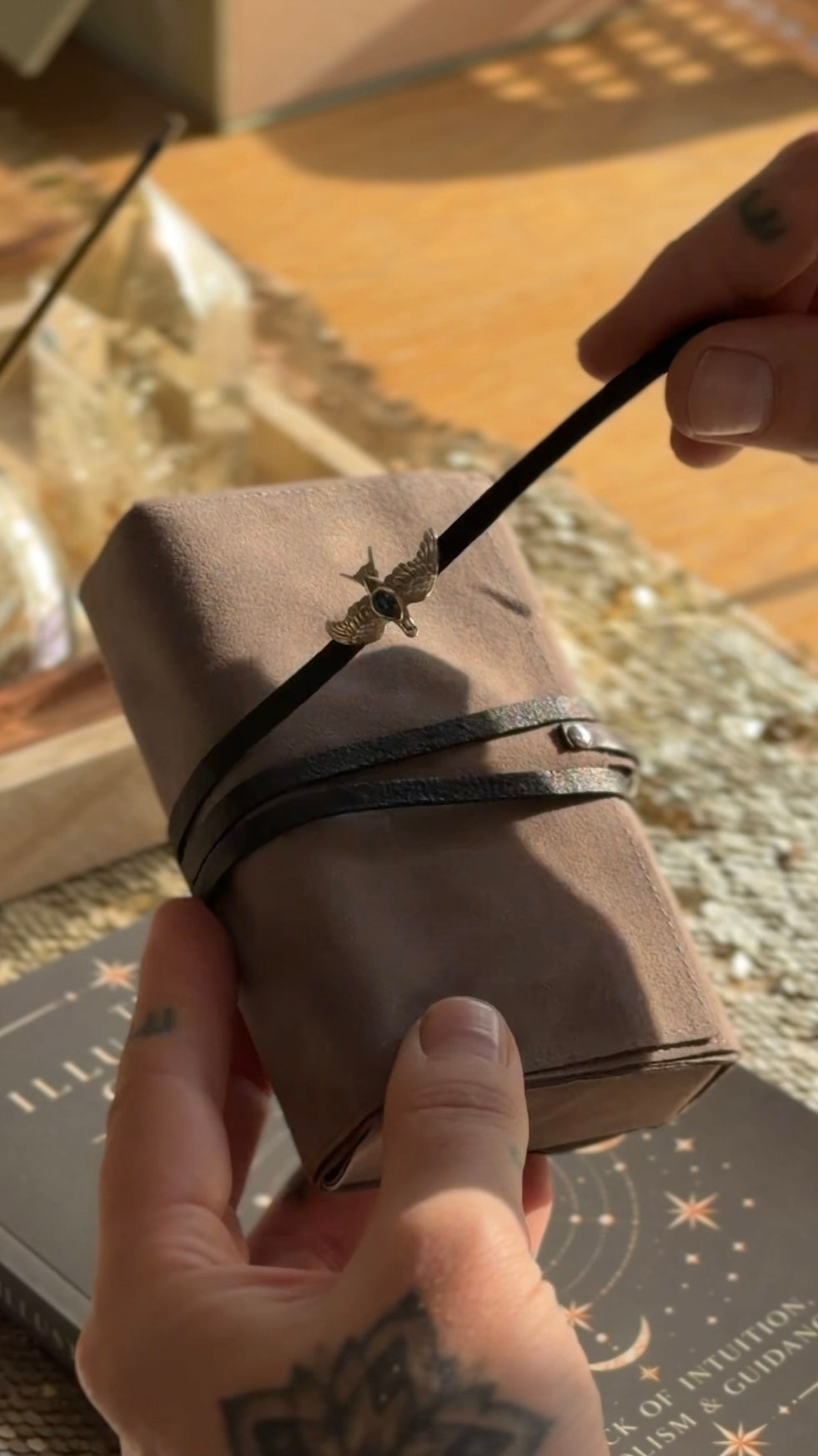
The Bespoke case is hand-stitched leather, closed with a cord that's tied by hand around a hand-finished buckle — and the buckle is where this project stops being a stationery product and becomes a jewellery one. It's cast in gold vermeil and set with a gemstone, using the same casting, setting and finishing techniques that go into every ring and pendant we make. It's the one part of The Illustrated Oracle that couldn't have been outsourced to a printer; it had to be made on the same bench as the rest of the collection.

The finished Bespoke case, before the buckle is fitted.
Each buckle is made the same way every piece in our jewellery collection is made: it begins as a sketch, becomes a CAD model, and is then cast, stone-set and hand-finished on the same bench as our rings and pendants. Every one is coated in a luxurious 18ct gold vermeil — partly for the finish, and partly because that plating is what protects the piece, and the cards it closes, through years of use. It's shaped as a swallow in flight, the same mark of safe return that runs through the rest of our jewellery.

The finished swallow buckle — 18ct gold vermeil, hand-set with a gemstone, made on the same bench as our rings.

Closing the deck back onto its guidebook, ready for the next reading.
Entry, Signature or Bespoke — the deck is the same. What you're choosing is how it's held. Shop The Illustrated Oracle.

Written by James Robinson