Lab-Grown Diamonds vs Natural Diamonds: What Nobody Tells You Before You Buy
There is no question we get asked more often, and no question that deserves a more honest answer.
Lab-grown diamonds. Natural diamonds. The marketing around both is loud, and the truth tends to get lost somewhere in the middle. So here it is — plainly, without agenda, and without trying to sell you something you haven't already decided you want.
They Are the Same Stone. That Part Is True.
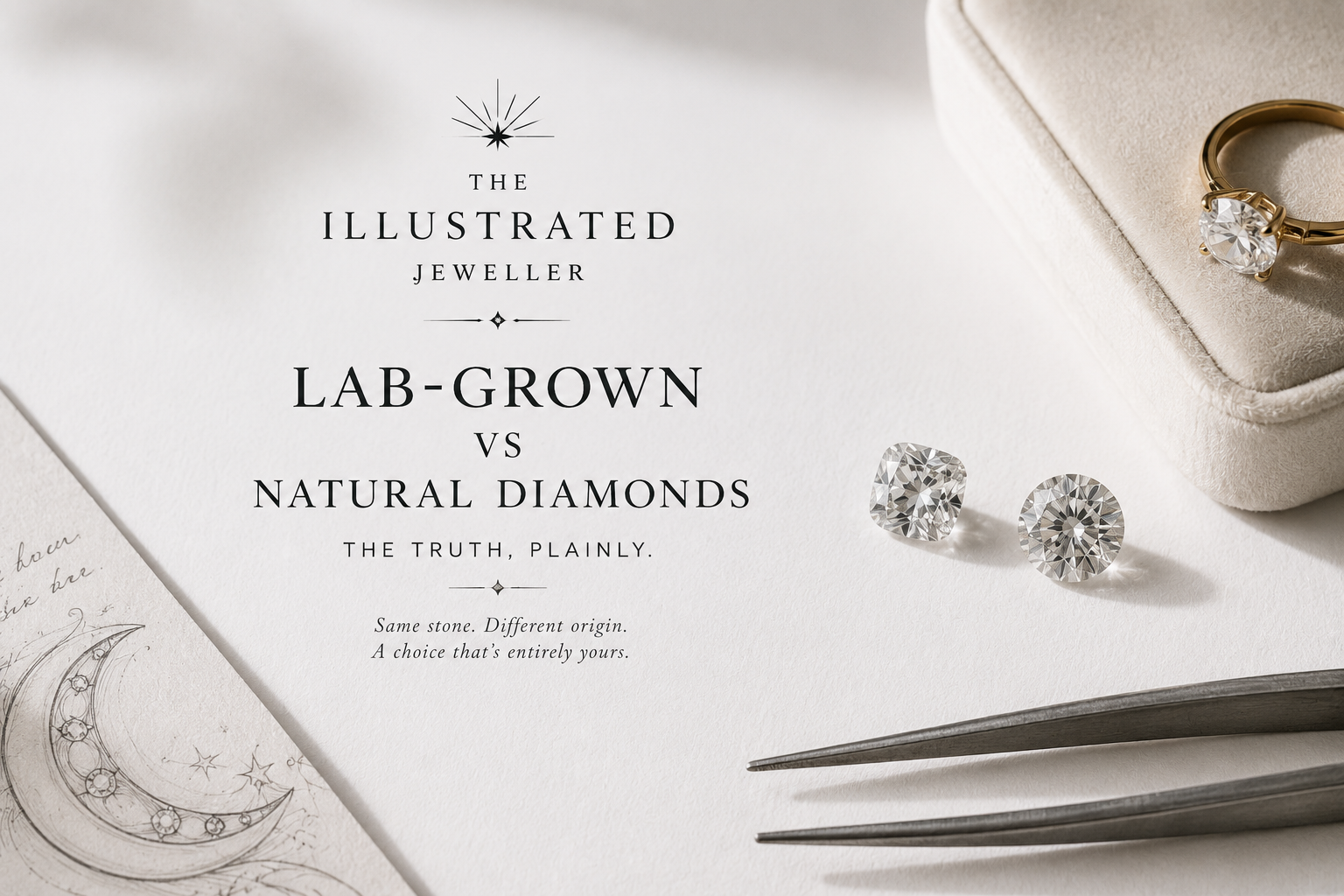
A lab-grown diamond and a natural diamond are, chemically and optically, identical. The same hardness, the same brilliance, the same fire. If you placed them side by side, you could not tell them apart with the naked eye. The difference is not what they are. It is how they came to be.
A natural diamond formed deep inside the earth over billions of years, under conditions of extreme heat and pressure that cannot be replicated at human scale. A lab-grown diamond was created in a factory most commonly in China, in a matter of weeks, using technology that mimics that same process. Both are real diamonds. The origin story is just very, very different.
The Price Gap Is Staggering — And Growing
A few years ago, a one-carat, top-quality lab-grown diamond D to F colour, VS clarity would cost a jeweller around £2,500 at trade. Today, that same stone costs substantially less, and typically a few hundred pounds.
Meanwhile, a natural one-carat diamond of equivalent quality sits at somewhere between £10,000 and £15,000.
That gap exists because lab-grown diamonds are a manufactured product. Supply is effectively unlimited. And as production has scaled, the price has fallen and continues to fall.
What That Means for Value
This is where the conversation gets important, and where a lot of jewellers go quiet.
If you buy a lab-grown diamond ring today for £2,000, and you have it revalued in six months, you could find that an equivalent ring can now be replaced for £1,000. The stone itself will not have changed. The market will have.
Natural diamonds and particularly natural coloured gemstones like rubies, sapphires and emeralds have historically gone up in value over time. Not because jewellery is an investment vehicle (it isn't, and anyone telling you otherwise is misleading you), but because if you have a piece valued for insurance purposes today, and do the same thing in five or ten years, the like-for-like replacement cost in the same market tends to rise.
That cannot be said for lab-grown diamonds right now. And it is a conversation worth having before you buy.
So Which Is Right for You?
Honestly? That depends entirely on what matters to you.
If size matters more than origin if you want the most diamond for your budget and the story of how it was formed is not something you think about — a lab-grown diamond is a perfectly beautiful choice. Buy it because you love it. Pay a price you are happy with. Just do not buy it as an investment, because it is not one.
If rarity matters to you if you want something that took billions of years to form, that exists in finite supply, that carries a story as long as the earth itself then a natural diamond, or a natural coloured gemstone, is what will feel right in your hand and on your finger.
At The Illustrated Jeweller, we work with both. What we will always do is make sure you know exactly what you are buying, and exactly why we have priced it the way we have. That conversation starts at consultation, and it never ends until you are certain.
Ready to talk through your options? Book a consultation at theillustratedjeweller.com/pages/consultations

Written by James Robinson