How to Choose a Gemstone: The Four Things You Must Know Before Saying Yes
I have sat across from hundreds of people over the years in tattoo studios, in jewellery consultations, at kitchen tables with a cup of tea and a ring sketch on a napkin and the moment someone falls in love with a gemstone is always the same. They hold it up to the light, something shifts in their face, and they say yes.
That instinct is not wrong. Jewellery has always been an emotional purchase. It was emotional when my great-great-grandfather Albert Self set sail, and the partners who loved sailors wore stones close to their skin like talismans. It is emotional now. That never changes.
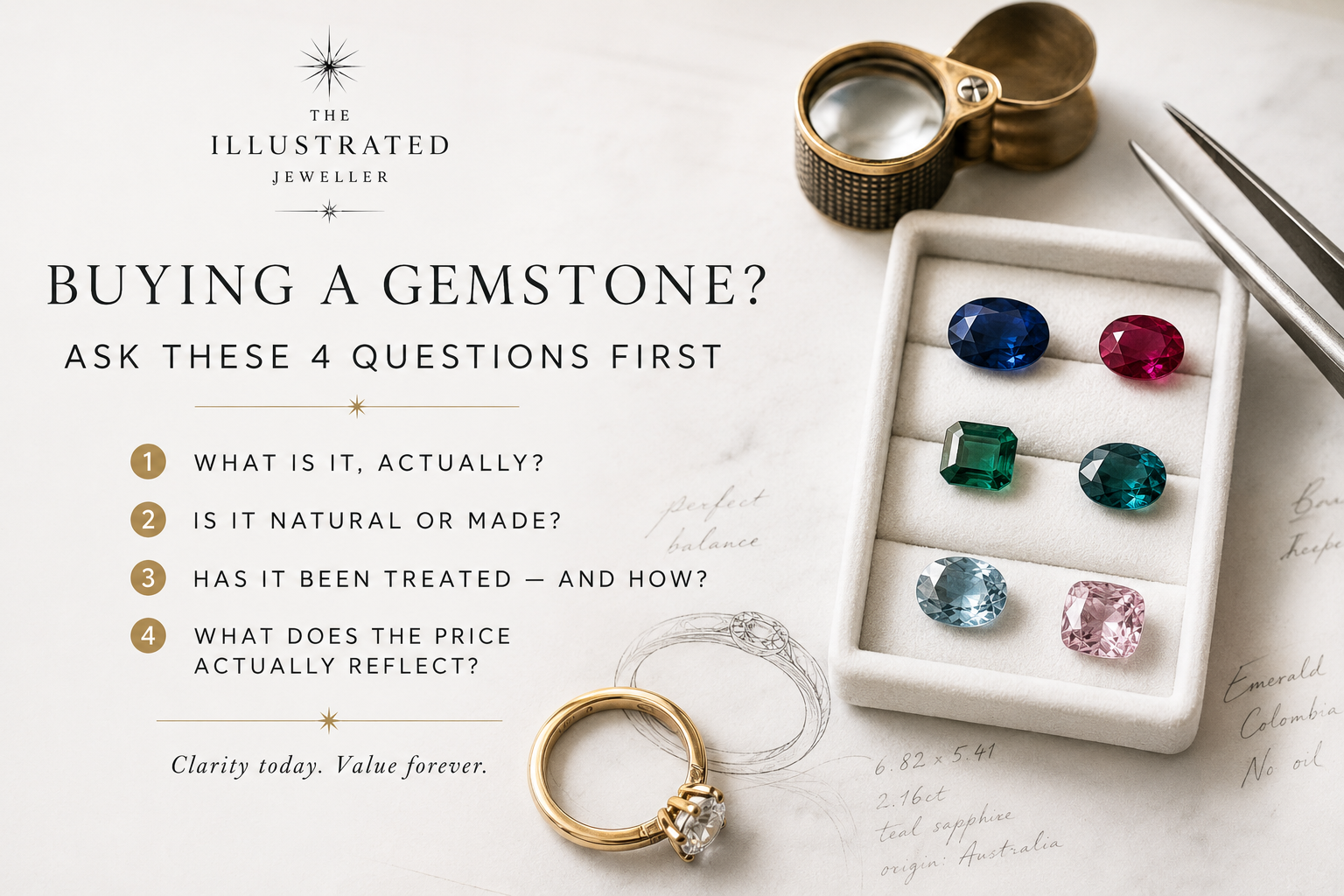
But before that moment of yes, there are four questions I always ask on behalf of my clients. Not to complicate the magic but to protect it. Because nothing kills the joy of a beautiful piece faster than finding out later that the stone at the heart of it is not what you thought it was.
1. What Is It, Actually?
This sounds obvious. It is not.
The gemstone world is full of stones that look identical to the naked eye but are entirely different materials with entirely different values. A blue stone on a tray could be a sapphire, a spinel, a kyanite, a piece of glass, or a coated topaz. Two of those are precious. Two are not.
What matters is the material identity — is this a sapphire, a tourmaline, an emerald, or something else entirely? And this is not something you can answer from a photograph. Not even the most experienced gemologists in the world can identify a faceted coloured stone from a picture. Anyone who tells you they can should not be trusted with your money.
This is why, at The Illustrated Jeweller, we work only with dealers we have tested, questioned, and built real relationships with over time. We ask the hard questions so you never have to.
2. Is It Natural, or Was It Made?
Synthetic gemstones are not a new thing. We have had synthetic rubies and sapphires on the market for over 120 years. They are simply better marketed now than they used to be.
A natural gemstone formed in the earth over millions of years under extraordinary geological conditions. A synthetic gemstone is an exact chemical copy, grown in a laboratory. Both are real materials. But they are not the same thing, and they are not valued the same way.
Natural rubies, sapphires and emeralds have risen in value year on year. They are becoming rarer, not more common. The stones I source for the Lost at Sea collection: the pieces rooted in the “Lost at Sea” collection story, in the sea, in something that has endured are always natural. That is not a rule. It is a belief.
But whatever you choose, you deserve to know what you are buying. That is not negotiable.
3. Has It Been Treated — and How?
Almost every coloured gemstone on the market has been treated in some way. Heating is the most common, and the most accepted. A heated sapphire is still a sapphire, the treatment improves the colour, and the industry has disclosed this openly for decades.
But there are treatments that go much further. Glass-filled stones. Coated stones. Composite stones built from two entirely different materials fused together. These behave differently over time, require different care, and are priced very differently when they are priced honestly.
A glass-filled sapphire can cost around £1 per carat at a gem fair. A natural untreated sapphire of the same size and colour can cost thousands of pounds per carat. If you do not know what you have, you cannot know what it is worth, and neither can your insurer.
Any jeweller worth working with will tell you, unprompted, whether a stone has been treated and how. If they do not know, walk away.
4. What Does the Price Actually Reflect?
Gemstone pricing can seem random. It is not, but you need to know what you are looking at.
Origin matters. A Colombian emerald commands a significant premium over a Brazilian emerald of identical quality, simply because of where it came from. That is the market, not the material.
Cut matters more than most people realise. A poorly cut stone carries weight in all the wrong places. You pay by the carat, so a deep, heavy belly that disappears into a setting is weight you have paid for and gained nothing from.
Demand matters. Teal sapphires once dismissed as cheap, low-grade stones, quadrupled in price the moment the word teal started trending. The material did not change. The story around it did.
And one small inclusion can swing the price dramatically. I have a stone in my studio right now that looks like a bargain until the light catches a tiny feather inside it. That inclusion tells the whole story of why it is priced the way it is.
Knowing how to look, and knowing what you are looking at, is the difference between a piece you will treasure for generations and an expensive lesson.
At The Illustrated Jeweller, every stone we use has been chosen with all four of these questions already answered. Because the piece you wear should have a story you are proud of from the seabed to the setting.
Want us to source the right gemstone for your piece? Book a consultation at theillustratedjeweller.com/pages/consultations

Written by James Robinson