What “Ethical” Actually Means in Jewellery — And Why We Don’t Use That Word
Walk into almost any jewellery studio in the UK and you will find the word ethical somewhere. On the website, in the about page, on the little card tucked into the box. It is everywhere.
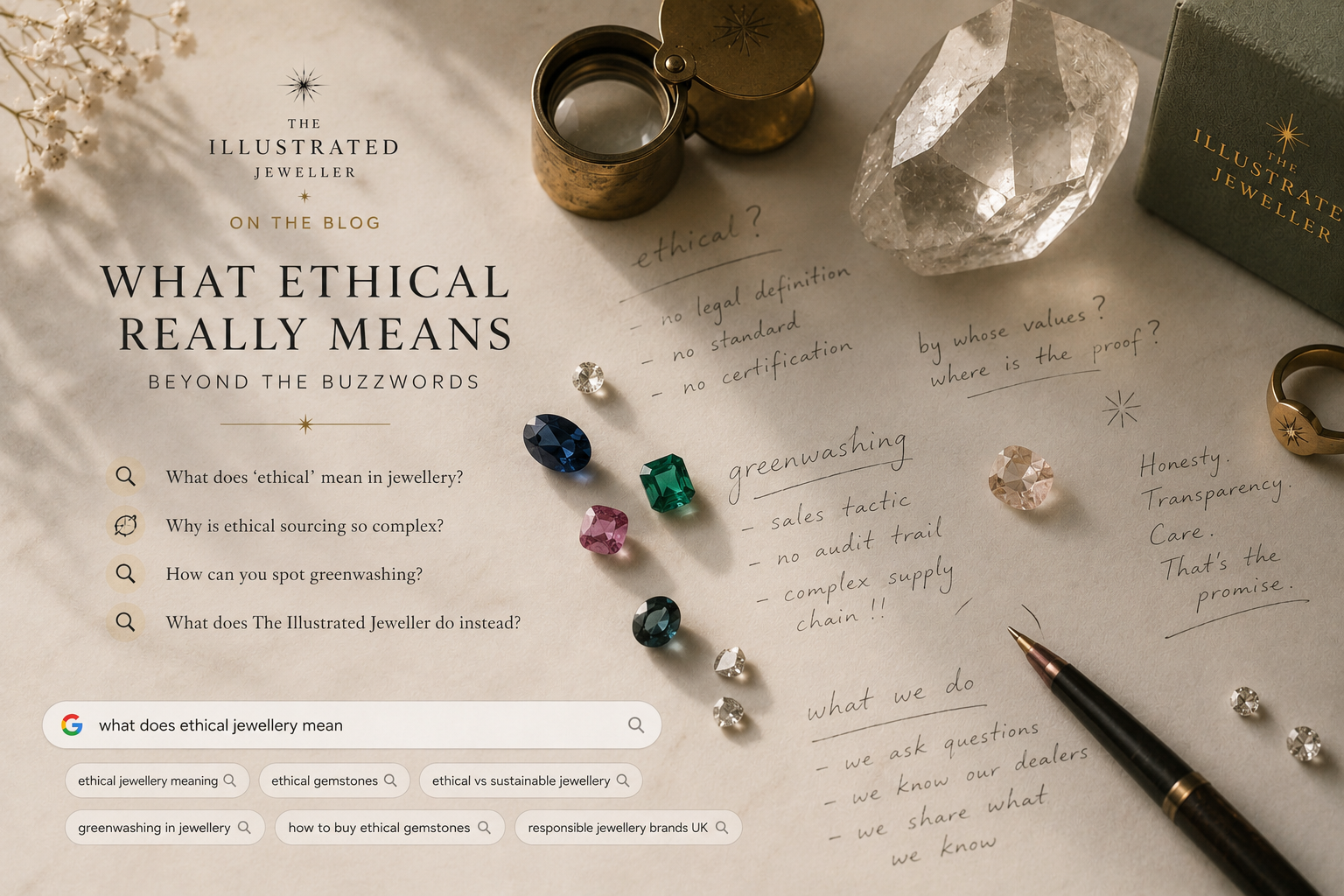
And yet there is no legal definition of it. No industry standard. No body that certifies it. No audit that confirms it.
I know this because I have asked. When I started building The Illustrated Jeweller, when I moved from two decades behind a tattoo needle to working with gold and gemstones, one of the first things I wanted to get right was how I talked about where my materials came from. I cared about it. I still do. But the more I looked into the word ethical, the less honest it felt to use it.
Here is why.
The Word Has No Fixed Meaning
Ethical means adhering to one's own values and morals. Which means an ethical gemstone can only ever be defined in relation to the person buying it, and what they personally believe should or should not have happened before that stone reached them.
For one person, ethical means no child labour anywhere in the supply chain. For another, it means fair wages for miners. For another, carbon-neutral processing. For another still, full traceability from mine to hand. These are not the same thing. A stone that satisfies one definition may fail every single other one.
So when a jeweller tells you a stone is ethical, the question you should immediately ask is: ethical by whose values, and where is your proof?
There are jewellers in the UK who have built entire reputations on the word ethical and cannot substantiate a fraction of what it implies. The coloured gemstone supply chain is one of the most complex in the world. Stones pass through multiple hands, multiple countries, multiple markets before they reach a workbench in Brighton. A robust, end-to-end audit trail is genuinely, extraordinarily difficult to achieve.
Putting the word ethical on a product without that trail is greenwashing. It is also a sales technique, because a stone described as ethical can command double the price of the same stone without the label.
We do not call our gemstones ethical. We call them ours, and we tell you exactly what that means.
We source from dealers we have known and trusted over time, people whose knowledge, integrity and practices we can vouch for from direct experience. We ask the questions that matter at every stage: what is the material, what is its origin, has it been treated, and how. We do not buy from people who cannot answer those questions clearly and confidently.
The stones in the Lost at Sea collection: the pieces built around the story of my great-great-grandfather Albert Self, lost at sea on Christmas Day 1885 carry weight beyond the material. They are chosen carefully, held carefully, and set carefully. That care is the closest thing to a guarantee I can honestly offer.
So when you ask us about our sourcing, and we hope you do, we will not hand you a label. We will tell you how we work, who we work with, and why. We will tell you what we know, and what we do not know. And then we will let you decide whether that sits right with your values.
Because ultimately, that is the only definition of ethical that matters. Yours.
Want to know more about how we work? Read our story at theillustratedjeweller.com/pages/about

Written by James Robinson